

May Journal — The Collagen Conversation (The One We Should Have Been Having All Along)
Grab a cuppa. Sit in the garden if you can. Let the sun touch your face for a moment — gently, not harshly — and let’s talk about something that’s been shouted at us from every direction…
Collagen.
You’ve seen it.
Powders. Pills. Peptides. Promises.
And yet… very few are talking about what collagen actually is, what it does, and more importantly — how your body already knows exactly how to make it.
Now you’re here, sit somewhere you can breathe a little deeper… somewhere you feel comfortable.
Because this isn’t going to be a quick read.
This is one of those conversations that asks you to slow down…
to look a little closer…
and maybe unlearn a few things along the way.
This month, I’m talking about collagen — and I’ve chosen this intentionally.
It’s something that keeps coming up —
in conversations, in passing questions, in those quiet moments where someone leans in and asks honestly…
“What do you think about collagen?”
“Should I be taking it?”
“Is it worth it?”
And I understand why.
Because it’s everywhere.
Across media, across wellness brands, across the beauty industry —
collagen has become the latest focus, the latest promise, the latest thing we’re told we need to maintain, restore, or replace.
Alongside it…
Botox. Fillers. Treatments.
Supplements that claim to reverse, plump, rebuild.
And somewhere in all of that noise, something important has been lost.
The understanding of what collagen actually is…
what it does…
and how the body already works with it.

So, what is collagen really?
Collagen isn’t a trend.
It’s the most abundant protein in the human body — a structural one, yes — but more than that, it’s what gives form, strength and integrity to so many of our tissues.
It’s in the skin, of course.
But also in the joints, bones, tendons, ligaments, blood vessels, the lining of the gut… and within the fascia — that intelligent, responsive web beneath the surface that connects everything together.
So when we talk about collagen, we’re not talking about beauty alone.
We’re talking about function.
About resilience.
About how the body quite literally holds itself together.
And even collagen itself isn’t one single thing.
There are different types throughout the body — some more concentrated;
Type I skin, tendons and bones,
Type II cartilage, blood vessels,
Type III organs, blood vessels, fascia/supportive tissues
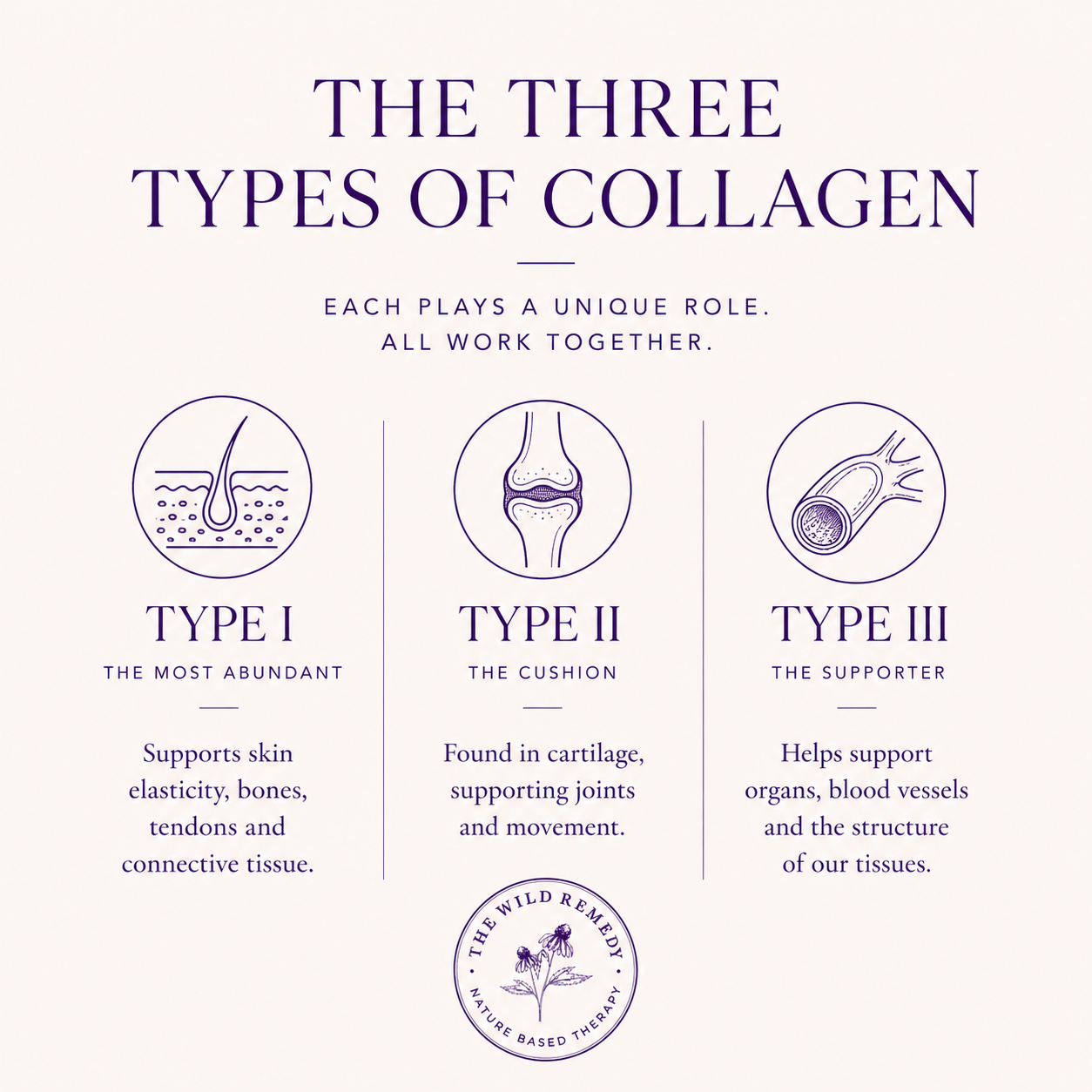
Which again reminds us that collagen is not purely cosmetic.
It’s woven throughout the body’s entire structure.
Collagen is constantly being built, broken down and renewed within the body.
Specialised cells called fibroblasts help create collagen by using amino acids (the building blocks of protein), alongside nutrients like vitamin C, minerals and adequate energy from food and rest.
This process forms collagen chains and fibres that give structure, flexibility and support throughout the body.
Which means collagen isn’t a static thing we simply “take” — it’s an active, ongoing process influenced by how we live, nourish, move and recover.
And yet somewhere along the way, collagen became reduced to a marketing trend…
The truth? Collagen doesn’t act alone.
The body is not waiting for collagen to arrive from the outside.
It is constantly making it.
This process — collagen synthesis — is ongoing and dependent on a number of factors working together.
Amino acids (from protein — particularly glycine, proline and lysine)
Vitamin C (essential for forming stable collagen fibres)
Zinc and copper (key cofactors in enzymatic reactions)
Silica and other trace minerals
Energy, digestion, and overall metabolic balance
Without these, the body simply cannot build collagen effectively.
This is not about adding collagen.
It’s about whether the body has what it needs to create and maintain it.
What’s actually happening inside your body
Collagen is constantly being broken down and rebuilt.
That’s normal.
But the balance can shift.
Breakdown increases with:
UV exposure
Chronic stress
Poor sleep
High sugar intake (glycation damages collagen fibres)
Inflammation
Environmental stressors
Lack of physical activity
And something we don’t often consider…
This balance is also influenced by seasons.
The seasons around us — sunlight, cold, dryness, changes in light — all affect the skin and connective tissues.
And the seasons within us too.
Stress. Hormonal changes. Different stages of life. Recovery. Growth.
The body is not static.
It responds, adapts, recalibrates.
So what we often interpret as “collagen loss”…
is often a reflection of changing conditions — internally and externally — affecting repair and renewal.

Looking at collagen differently
This is where things began to shift for me.
Not through a product.
Not through a quick fix.
But through listening to and studying the body — and seeing collagen not as something to chase… but as something to support.
As I continue my training in herbal medicine, one principle keeps returning:
We don’t treat parts in isolation.
We support systems.
Collagen sits within digestion, circulation, the nervous system, hormonal balance…
So when someone asks about collagen, the deeper question becomes:
Is the body supported enough to make it well?
A note on supplements (with honesty)
Collagen supplements are widely promoted.
And while some research suggests potential benefits in certain contexts, what’s often not explained is this:
Collagen is broken down during digestion into amino acids.
It doesn’t simply travel to the skin and “fill” lines.
The body will use those building blocks where it needs them most.
And because the body is adaptive, there are ongoing discussions — not definitive conclusions — around how consistent external supply may influence internal production pathways.
So this isn’t about dismissing supplements.
It’s about understanding them.
And not overlooking the intelligence of the body itself.
Free radicals, antioxidants… and what that really means
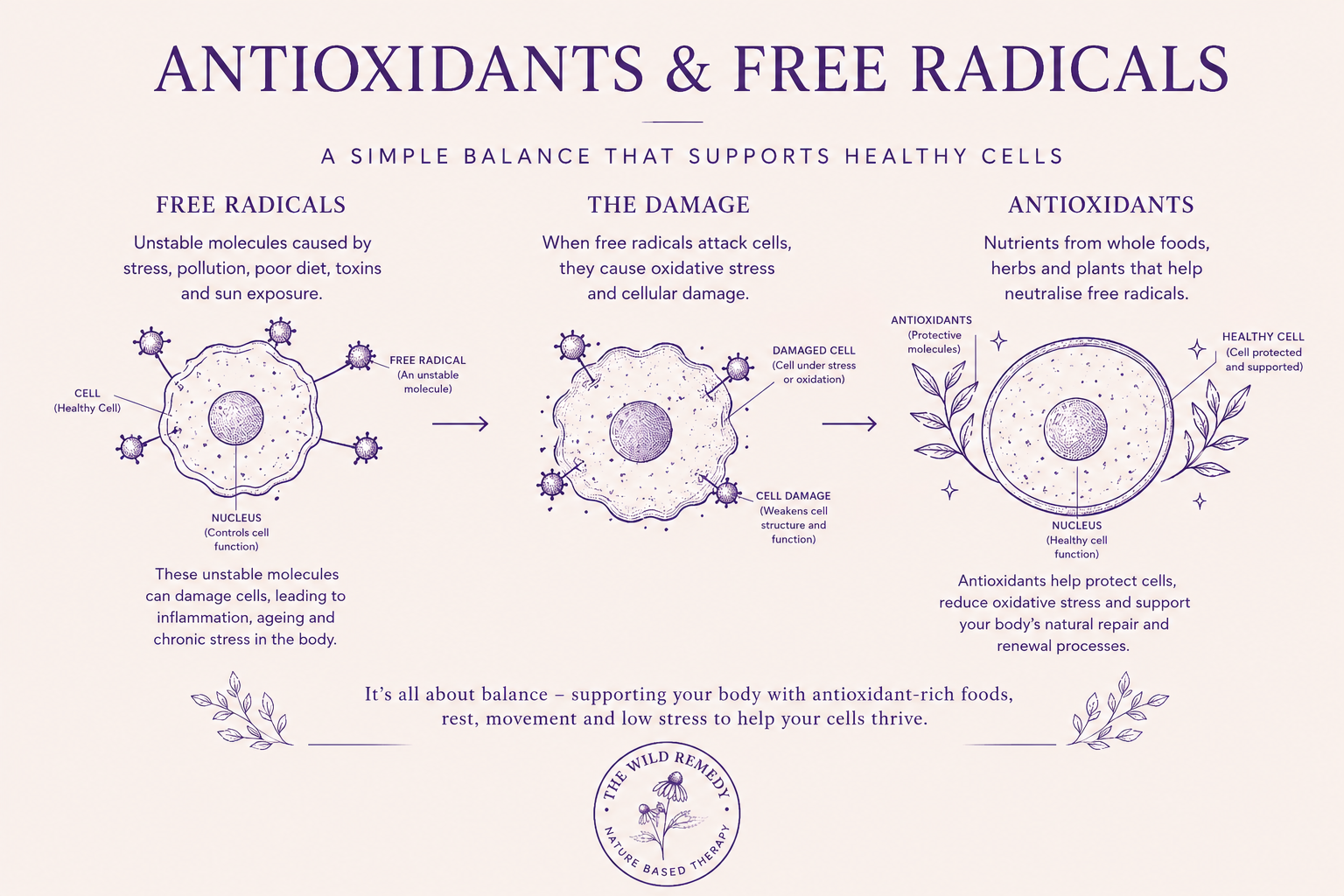
This is an area my herbal medicine studies have focussed on recently. Free radicals are unstable molecules that damage cells — including those involved in collagen.
They increase with:
stress
environmental exposure
poor diet
lack of sleep
Antioxidants help neutralise this damage.
So when you drink herbal infusions, eat whole foods, include plants in your routine…
you’re not chasing beauty.
You’re supporting repair.
The wider picture (and a quiet truth)
The growth of the collagen and anti-ageing industry sits within a broader system — one that includes pharmaceutical, cosmetic and aesthetic sectors.
This doesn’t make it all wrong.
But it does shape the narrative.
A narrative that often centres on loss — and the need to correct it.
At the same time, we’re living in a moment where “wellness” is being presented in very specific ways.
Smooth skin. Effortless ageing. A single product as the reason why.
And while there’s nothing wrong with wanting to care for how we look, it’s worth holding a wider awareness.
Because what we see isn’t always the full picture.
There are often layers behind those results — treatments, procedures, interventions — that aren’t always spoken about.
And when those layers aren’t acknowledged, it can create a quiet sense that we’re missing something… or not doing enough.
When in reality, the body doesn’t work in shortcuts.
It responds to what it’s consistently given — over time.

Everything is connected
Collagen doesn’t exist in isolation.
It reflects your nutrition, your sleep, your stress levels, your movement, your internal environment.
Because the truth is — everything is connected.
Collagen isn’t just influenced by what we eat, or what we apply to the skin.
It’s shaped by how we move, how we rest, how we respond to stress, how we spend time in nature, how well we absorb nutrients, how supported our nervous system feels.
Movement, for example, plays a bigger role than we often realise.
When we move — whether that’s walking, stretching, or strength work — we increase circulation, helping deliver oxygen, minerals, and nutrients the body needs to build and repair. At the same time, our tissues are gently stimulated, signalling the body to maintain strength and structure.
Fascia — that connective network beneath the skin, rich in collagen — responds directly to this. It becomes more hydrated, more elastic, more resilient.
Hydration matters here too — not in the oversimplified “drink more water” way we often hear online, but because collagen-rich tissues rely on water, minerals and circulation to remain supple, resilient and able to repair well.
Rest supports repair.
Light, air, and environment influence the skin and internal rhythms.
Herbs and whole foods provide the building blocks and protection.
None of these work in isolation.
They work together.
And when we begin to see the body this way, the focus shifts…
From trying to fix one thing —
to supporting the whole.
Step outside this month and you’ll see it reflected everywhere.
Nettle thriving.
Herbs waking.
Growth happening steadily, not rushed.
Nothing in nature is forcing itself into bloom.
It responds to the conditions around it.
And the body is no different.
So what does this actually look like in real life?
This is usually the point where the question shifts.
From understanding…
to “okay, but what do you actually do?”
It’s something that keeps coming up —
in conversations, in passing questions, in those quiet moments where someone leans in and asks honestly…
“What do you actually use?”
“What does your day look like?”
So here’s a snapshot — not a routine to follow, just what’s been supporting me.
I keep things consistent, but I also listen — because the body will tell you what it needs if you give it the space.
Lately, that’s looked like a blend of chaga and tremella mushroom, alongside rose powder, and at times shilajit.
Not because they “add collagen” — but because of how they support the body as a whole.
Tremella supports hydration at a cellular level
Chaga offers antioxidant support and has been studied for helping defend skin cells from UV-related oxidative stress
Rose supports both the skin and nervous system
Shilajit supports mineral status and overall vitality
Movement
Breathwork
Alongside this, my daily rosehip and nettle tea has become something I return to again and again and is becoming a favourite blend in our Wild Circle community-sign up to get yours).
And then there’s food — always the foundation.
Avocados. Eggs. Leafy Green Veg. Greek yoghurt. Frozen blueberries. Milled seeds and nuts.
Over time I’ve become much more mindful about where herbs, mushrooms and mineral products come from too. Some of the blends and extracts I personally use are from Ancient Extracts, largely because their approach to sourcing, purity and third-party testing aligns with the slower, more intentional way I now try to support my body.
Simple. Nourishing. Consistent.
Because this isn’t about adding collagen.
It’s about supporting the body’s ability to produce, protect and maintain it.
You might have noticed I’ve mentioned a few mushrooms and plant extracts here — and that’s something I’ll explore properly in a future journal.
Because they deserve more than a passing mention.
And of course, this conversation could keep unfolding.
Turmeric. Aloe. Green tea. Sea buckthorn. Adaptogens. Mineral-rich foods. Different cultural practices and traditions that have supported skin, healing and connective tissue for generations.
There’s no single herb responsible for “perfect” skin or collagen.
And perhaps that’s the point.
What we choose is often shaped by culture, access, lived experience, taste, knowledge, ancestry, environment… and learning to listen to our own bodies and being open to try new things if your diet is lacking key nutrients.
So rather than offering a rigid formula, I hope this journal offers something gentler:
A starting point.
A different perspective.
An invitation to become more connected to the body you already live in.
If you’re starting somewhere… start here
A simple place to begin:
Nourish your body with real food 🍽️
Support with minerals and Vitamin C 🍊
Move regularly 🤸🏼♀️
Rest properly 💤
Spend time outside 🌞
If there’s a subject, symptom, ritual or part of the body you’d love us to explore in a future journal, you can always reach out or sign up to our Wild Circle or contact form. Your questions, reflections and willingness to learn alongside me as I continue my herbal medicine studies are helping shape this space into something deeper — bringing us all a little closer to understanding the body, nature and the quieter ways we can support ourselves, as I truly believe they were always intended to work together.
You might have noticed I haven’t included a Garden Note this month — and that’s intentional.
May in the garden deserves its own space.
So I’ll be sharing a separate Journal dedicated to what’s happening right now — what to sow, what to harvest, what to gently tend to… whether you have a garden, a balcony, or just a few pots on a windowsill.
Because just like the body, the garden moves in its own rhythm.

Final thought
Perhaps part of this journey is learning to trust the body a little more — to see it not as something constantly needing correction, but something deeply intelligent by design.
Collagen isn’t something to chase.
It’s something your body already understands.
The shift… is remembering that.
With love,
Bee 🐝
💜Shop our natural collection here
💜Sign up to our Wild Circle community for pre release skincare and a deeper sharing of The Wild Remedy
💜Unlock 10% discount on our debut Handcrafted Magnesium Butter here
💜 To book a nature based workshop for your occassion.
References & Further Reading
DePhillipo, N.N. et al. (2018). Vitamin C and collagen synthesis in musculoskeletal tissues.
Pullar, J.M. et al. (2017). The roles of vitamin C in skin health.
Ricard-Blum, S. (2011). The collagen family.
Mills, S. & Bone, K. (2013). Principles and Practice of Phytotherapy.
Hoffmann, D. (2003). Medical Herbalism.
Hobbs, C. Medicinal Mushrooms.