

Native Healers: Foundations in Western Herbal Medicine — Anita Ralph & Mary Tassell
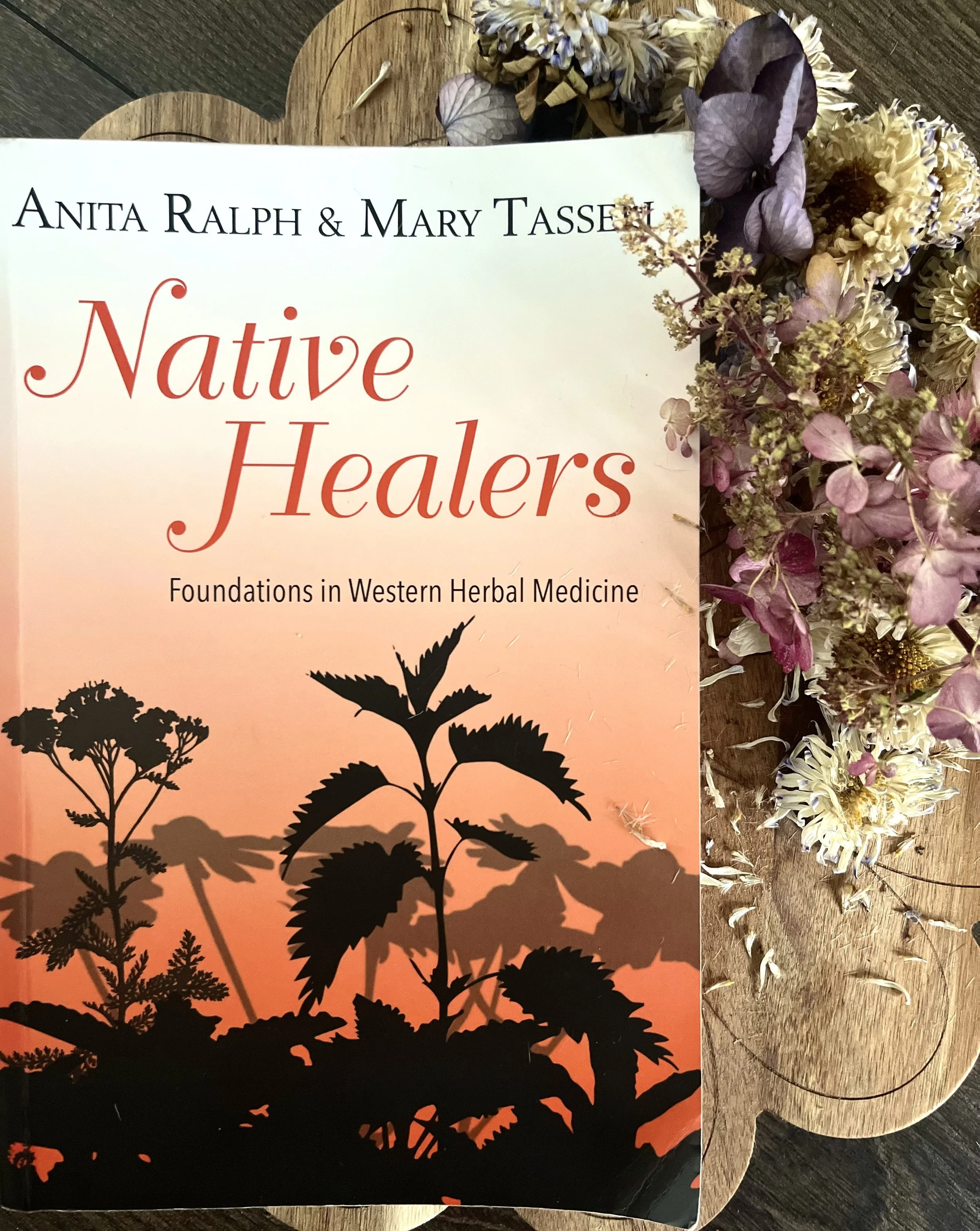
When a book calls itself a “foundation,” I expect three things: clarity, courage, and care. Anita Ralph and Mary Tassell deliver all three in Native Healers, and they do it without fanfare. This is a book that sits happily between bench and bedside—equally at home next to a microscope slide as it is beside a kettle and a jar of dried chamomile.
I’ve been reading it as one of the core texts on my desk while I begin my formal herbal studies. It’s become the book I reach for when I want to bridge the why (pharmacology – the science of how plants act in the body) with the how (formulation – choosing and combining herbs safely and effectively). Below is an honest reflection—what it does beautifully, where I pushed back, and how it’s shaping my practice at The Wild Remedy.
What it does beautifully
1) A true “foundation” rather than a loose anthology.
Ralph & Tassell organise Western herbal medicine into an integrated model: botany (the study of plant structure) → constituents (the active chemical compounds in a plant, such as tannins or flavonoids) → actions (how those compounds work in the body, e.g. anti-inflammatory, soothing, toning) → body systems → people. You feel the scaffolding as you read; it’s teaching you to think, not just to memorise. Their materia medica entries (individual plant profiles) read like living monographs—clear actions, key constituents, practical preparations, and clinical “touch points” that help you understand when a plant belongs in the plan.
2) Science and sense, hand in hand.
The authors move comfortably between phytochemistry (plant chemistry—tannins, saponins, sesquiterpene lactones) and sensory medicine (taste profiles, tissue states, energetics). Tissue states means recognising the “feel” of a body’s imbalance—too hot, too cold, too damp, too dry—and matching a plant to restore balance. Energetics is the herbal tradition of classifying plants by qualities like warming, cooling, moistening, drying. This dual fluency mirrors how many of us actually work: we read the paper, then we taste the plant. In that respect it sits neatly alongside Heinrich’s Fundamentals of Pharmacognosy & Phytotherapy (pharmacognosy = the study of medicines from natural sources) for chemistry and Kerry Bone’s Clinical Guide to Blending Liquid Herbs for formulation, while feeling more person-centred than either.
3) Safety and stewardship are not afterthoughts.
There’s steady attention to dosage, contraindications, and interactions—dosage = how much; contraindications = situations where a herb shouldn’t be used; interactions = how it might affect other medicines. Equally welcome is the ecological humility: an encouragement to grow, gather and buy ethically, with an eye on habitat, soil health, and sustainability. This aligns with how we plant and source for our skincare range at The Wild Remedy.
4) Case-led learning without heroics.
Where many texts lean into miracle-storytelling, Native Healers is measured. Case examples show pattern recognition (not protocol pushing) and nudge you to ask better questions: What is the tissue state here? What can I change with food, sleep, light, movement, and a few well-chosen plants?
Where I gently push back
1) “Western” can still be a wide lens—and wider still.
While the book acknowledges tradition, I sometimes wanted a deeper reckoning with how Western practice has borrowed from, or overwrote, Indigenous knowledge. In my October Notes I wrote about herbs—echinacea, black cohosh, turmeric—arriving via colonial trade routes and the appropriation of Indigenous knowledge. Native Healers gestures to history; I’d love an even clearer invitation to practise with credit, reciprocity, and repair in mind (sourcing, giving back, citing).

2) Evidence grading could be more explicit in places.
The authors are careful, but as a student I welcome clear flags—traditional use vs. preliminary trials vs. systematic review—so readers learn to weigh sources. (This is where pairing the book with Heinrich, Bone, and the Safety Handbook gives a fuller evidence map.)
3) Dosage ranges & prep choices.
This is a minor quibble, but for a few herbs I found myself wanting tighter dose bands and preparation rationales (why tea vs. tincture vs. glycerite in specific patient contexts—tincture = herb extracted in alcohol; glycerite = herb extracted in vegetable glycerine). Not a flaw—more an opportunity for a second edition appendix or online supplement.
Theology, ecology, and the ethics of care
A line I carry into all my work: “I have given you every herb bearing seed…” (Genesis 1:29). For me, that isn’t a slogan; it’s a responsibility. Native Healers reads as if it understands this—plants are gifts and fellow workers, not commodities. The authors encourage the reader to stay close to soil, season, and sensory knowing—which tracks with current research on grounding (making direct skin contact with the earth), microbiome diversity, and the mental-health impact of contact with nature and flowers (dopamine/serotonin/oxytocin pathways—chemicals in the brain associated with pleasure, mood and bonding). The book doesn’t do the lab-coat gloss; it does something braver: it keeps both evidence and embodiment in the room.
How it’s shaping my practice (and The Wild Remedy)
Clinical thinking: Better translation from “constituents” to “actions I can feel and observe.”
Making & growing: Clearer choices between fresh/dry, tea/tincture/infused oil—and why.
Stewardship: Stronger sourcing policy for our skincare herbs and our garden designs.
Teaching: I’ve adapted several of their frameworks for our workshops—watch for these in the Wild Circle as we move through the darker months (recipes, practical herb skills, skin-nourishing preparations, and seasonal self-care).
How it sits with other core texts
Pair with:
Fundamentals of Pharmacognosy & Phytotherapy (Heinrich et al.) — deeper chemistry & pharmacology.
Clinical Guide to Blending Liquid Herbs (Kerry Bone) — formulation logic & dispensary practice.
Botanical Safety Handbook (AHPA) — gold-standard safety cross-checks.
Encyclopedia of Herbal Medicine (Andrew Chevallier) — quick clinical cross-reference.
Read after:
Your own garden notebook and sensory notes. Native Healers becomes more luminous when you’re tasting your tinctures, pressing your flowers, and noticing tissue states in real bodies (including your own).
Who is this for?
Students & new practitioners who want a whole-practice primer (not just a list of herbs).
Growers and makers moving toward clinical craft and ethical sourcing.
Curious gardeners who feel, as I do, that the garden is a clinic and a classroom.
Verdict
Warmly recommended. Native Healers is the “steady hand” book I wish I had years ago: grounded enough to trust, humble enough to keep you curious. It teaches you to think like a herbalist—body, plant, place, and person—while reminding you that knowledge lives in soil, stories, and service, not just in citations.
If you’re travelling this path with me, consider adding it to your shelf. We’ll be unpacking themes from the book in upcoming Wild Circle shares and workshops—translating pages into teas, tinctures, salves, garden plans, and daily rituals. As always, if you’d like help creating a therapeutic planting plan for home or workplace—or you’re seeking skin-kind botanical products made with these same plants—reach out or, a seasonal workshop gathering of friends to craft together. We’re here to help you grow something healing.
And if some of these herbal terms are new to you, don’t worry — we’ll be unpacking them gently together in our Wild Circle community . 🌿